
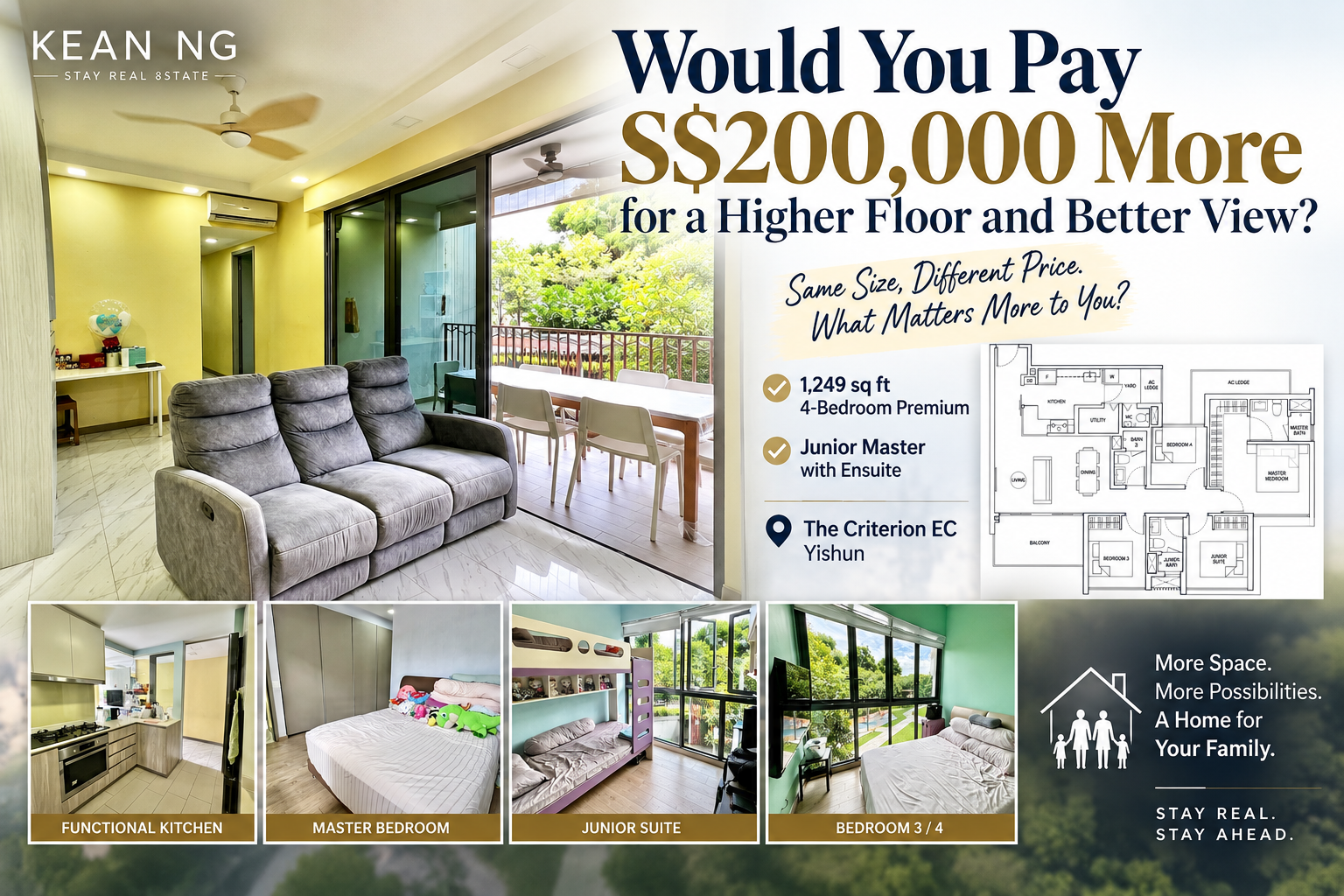

Would You Pay S$200,000 More for a Higher Floor and Better View?
When buying a condo in Singapore, many buyers naturally prefer a higher floor.
Better view. More privacy. Potentially less road or ground-level activity.
But here’s a question I think buyers should ask:
How much more are you actually willing to pay for it?
S$50,000?
S$100,000?
What if the difference approaches S$200,000?
I’m currently marketing a 4-Bedroom Premium unit at The Criterion EC in Yishun that presents exactly this question.
The unit is 1,249 sq ft, on the 2nd floor, and asking S$1.6 million.
At the time of comparison, another 1,249 sq ft 4-Bedroom Premium on a higher floor is being marketed at around S$1.8 million.
Same development. Same 1,249 sq ft size.
But potentially around S$200,000 difference in asking price.
So instead of simply asking whether a higher floor is better, I think there’s a more useful question:
Is the higher floor worth the additional price to you?
Note: The figures in this article refer to asking prices observed during the marketing period. Asking prices are not transacted prices or valuations and may change as listings are repriced, withdrawn or sold.
Why Do Buyers Prefer Higher-Floor Condo Units?
There are genuine reasons why many buyers prefer higher floors.
Depending on the development and facing, a higher-floor unit may offer a more open view, greater privacy, better ventilation and less activity immediately outside the home.
For some buyers, these factors are extremely important.
And if you walk into a high-floor unit with a beautiful unblocked view, there’s no denying the emotional appeal.
But there’s one mistake I sometimes see buyers make:
They assume higher floor automatically means better property.
It isn’t always that simple.
Lower Floor vs Higher Floor: Look Beyond the Floor Number
When I’m helping buyers compare resale properties, I prefer to look at the whole package.
Floor level is only one factor.
I would also consider the unit’s facing, actual noise level, afternoon sun, privacy, layout, usable space, condition and, importantly, price.
For example, a higher-floor unit facing a busy road may not necessarily feel quieter than a well-positioned lower-floor unit facing internally.
Likewise, paying substantially more for a higher floor may make sense to one buyer but very little sense to another.
That’s why I don’t believe buyers should decide based purely on the number beside the “#” sign.
A Real Example at The Criterion
This is a real comparison I’ve been thinking about while marketing a unit at The Criterion.
The unit offers:
4-Bedroom Premium layout
1,249 sq ft
Junior master with ensuite bathroom
2nd floor
Asking S$1.6 million
At the time I’m writing this, another 1,249 sq ft 4-Bedroom Premium on a higher floor is being marketed at around S$1.8 million.
That makes it a particularly useful comparison because we’re not comparing a larger unit against a smaller one.
We’re comparing the same 1,249 sq ft size at two very different asking prices.
There are also smaller 1,119 sq ft 4-bedroom units available.
Some higher-floor 1,119 sq ft units are being marketed at around S$1.7 million, with another asking around S$1.8 million.
These are still four-bedroom homes, but they’re approximately 130 sq ft smaller and don’t have the same junior-master configuration as the 1,249 sq ft Premium layout.
So now the buyer’s decision becomes more interesting.
It’s no longer simply:
Low floor or high floor?
It could be:
Would I rather have a higher floor, or would I prefer more space, the Premium layout and a junior master while keeping my purchase closer to S$1.6 million?
The Obvious Compromise: It’s on the 2nd Floor
I’m not going to disguise this.
If you’re specifically searching for a high-floor home with an elevated view, this probably isn’t the right unit for you.
There are buyers for whom floor level is non-negotiable.
And that’s perfectly reasonable.
But suppose your priorities are different.
Maybe you’re looking for enough space for three children.
Maybe your parents will be staying with you.
Maybe you need four proper bedrooms.
Perhaps the junior master with its own bathroom is more useful to your family.
Or perhaps S$1.6 million is simply the budget at which you feel comfortable buying.
Then suddenly the comparison becomes quite different.
Note: The figures in this article refer to asking prices observed during the marketing period. Asking prices are not transacted prices or valuations and may change as listings are repriced, withdrawn or sold.
What Does S$100,000–S$200,000 Mean to Your Family?
This is the part I think buyers sometimes overlook.
Let’s say S$1.6 million fits comfortably within your intended budget.
Your downpayment is manageable, the monthly mortgage works for your household, and you can still maintain sufficient savings after completing the purchase.
Then you see another property you like at S$1.7 million or S$1.8 million.
Can you afford it? Maybe.
But that’s different from asking:
Do you need to spend it? I think that’s an important distinction.
Buying a property isn’t necessarily about stretching to the maximum amount you’re able to afford.
Sometimes having more financial breathing room after buying your home can be valuable too.
Depending on your circumstances, that additional S$100,000–S$200,000 could go towards renovation and furnishings, reduce the amount you need to borrow, remain as emergency reserves, or simply give your family greater financial flexibility.
Of course, this doesn’t mean everyone should automatically choose the cheaper property.
Price difference alone doesn’t determine value.
The real question is:
What are you receiving in return for the additional money and is it important enough to you?
What If You’re Paying More for a Smaller Unit?
There’s another comparison worth considering.
If a higher-floor 1,119 sq ft 4-bedroom is being marketed around S$1.7 million–S$1.8 million, while this 1,249 sq ft 4-Bedroom Premium with junior master is asking S$1.6 million, you’re potentially paying more while accepting less internal space.
Again, that doesn’t automatically make the smaller unit a poor choice.
A buyer may strongly prefer its floor level, facing, view or another characteristic.
But it illustrates something important:
Paying more doesn’t necessarily mean you’re buying more space.
Sometimes you’re paying the premium for a different attribute.
In this case, one of those attributes may be floor level.
And that’s why buyers should understand exactly what their additional money is buying.
Price, Space or Floor – Which Matters Most?
If we simplify the current choices, there are essentially three things competing for your attention:
Budget. Space. Floor level.
At around S$1.6 million, you have this 1,249 sq ft 4-Bedroom Premium on the 2nd floor.
Move towards S$1.7 million, and there are higher-floor alternatives, including smaller 1,119 sq ft four-bedroom layouts.
Move towards S$1.8 million, and you may find both higher-floor 1,119 sq ft units and a higher-floor 1,249 sq ft Premium alternative.
There isn’t one property that automatically wins.
It depends on your priorities.
If floor level and view come first, paying more may make sense to you.
If space and layout come first, the 1,249 sq ft Premium becomes interesting.
And if S$1.6 million is already the budget at which your family feels financially comfortable, I wouldn’t automatically stretch another S$100,000–S$200,000 simply because you can.
I’d first ask:
What am I actually gaining for that additional money – and will my family benefit enough from it to justify paying for it?
Don’t Confuse Asking Price With Market Value
There’s another important point worth highlighting.
Just because one owner is asking S$1.8 million and another is asking S$1.6 million doesn’t automatically mean there is S$200,000 of “savings”.
An asking price is not a transaction.
Ultimately, the market determines what a property is worth when a willing buyer and seller agree on a price.
When Would I Pay More for a Higher Floor?
Personally, I would look closely at what actually changes.
If the higher floor gives me a dramatically better unblocked view, significantly greater privacy, better ventilation or solves a genuine noise issue, then I can understand paying a premium.
But if I’m paying substantially more primarily because one unit is on a higher floor, while the size, layout and overall living experience remain broadly similar, I would think carefully about how much that difference is worth.
Every buyer will arrive at a different answer.
And that’s perfectly fine.
Who Might This Criterion Unit Suit?
I think this particular unit is better suited to a buyer who puts space, practicality and budget ahead of floor level.
The 1,249 sq ft 4-Bedroom Premium layout gives families room to grow, while the junior master with ensuite provides additional flexibility.
It can be particularly useful for a multi-generational family where parents may appreciate having their own bathroom.
It could also suit a family with older children who want greater privacy.
Most importantly, it could suit someone who says:
“S$1.6 million is where I’m comfortable. I don’t need to stretch another S$100,000–S$200,000 just to say I’m on a higher floor.”
If that’s your thinking, then this unit may deserve a closer look.
My Stay Real Thoughts
After many years of helping buyers and sellers, one thing I’ve learnt is that there is rarely a perfect property.
A higher-floor unit may have the view but cost considerably more.
A lower-floor unit may require a compromise on elevation but offer more attractive pricing.
A smaller unit may be on a higher floor.
A larger unit may give your family a more practical layout.
One unit may have the perfect facing but require renovation.
Another may look less impressive initially but fit your family’s finances much more comfortably.
Property buying is ultimately about understanding which compromises matter to you and which ones don’t.
That’s why I don’t believe buyers should simply chase the “best” unit.
I would rather help my buyers understand:
What am I paying for?
Will my family actually benefit from it?
Can I comfortably afford it without unnecessarily stretching myself?
And is the additional premium worth it for the way we’re going to use this home?
Once you can answer those questions, property comparison becomes much clearer.
Already Considering The Criterion?
I’ve also written a separate blog which I am marketing for The Criterion EC, covering the development, connectivity, shopping and lifestyle amenities, nearby schools, condominium facilities and why the development may appeal to families.
[Read my blog to The Criterion here]
Looking for a Spacious 4-Bedroom Home?
If you’re looking for a larger family home around Yishun and you’re open to compromising on floor level in exchange for space, layout and a more comfortable purchase price, you’re welcome to take a look at this 1,249 sq ft 4-Bedroom Premium at The Criterion.
Don’t decide based on the floor number or listing photos alone.
Come down, stand inside the actual unit, experience the facing and surroundings, look at how your family could use the space, and then decide whether being on the 2nd floor genuinely bothers you.
If it does, this probably isn’t your unit.
But if it doesn’t, then the difference between S$1.6 million and some of the higher-floor asking prices becomes something worth thinking about.
Looking to buy or sell a property? Get in touch with me for a discussion about your options.
📚 Related Articles
➡️ The Criterion EC 4 Bedroom For Sale
➡️ How Much Is My HDB Worth In 2026?
➡️ Rare Dual-Key HDB Flats: Are They Worth Buying?
➡️ 5 Lesson Every HDB Owners Can Learn
➡️ Real Upgrade Journey: HDB to Condo Guide
➡️ What Should You Do With Your Property Profits?
➡️ Best Advice Not To Sell Your HDB Yet
➡️ Why Real Estate Is a Powerful Wealth Building Tool
➡️ 15 months wait out period removed: What it mean for homeowners
➡️ 6 Weeks After the 15-Month Wait Was Removed: What Changed?