


On 28 July 2026, the Government removed the 15-month wait-out period for eligible private property owners who want to purchase a non-subsidised HDB resale flat without taking an HDB housing loan.
When the announcement came out, there were plenty of predictions.
Would more private homeowners sell and right-size into HDB flats?
Would HDB resale prices start climbing again?
Would more private properties come onto the market?
And could rental demand be affected now that some homeowners no longer need to rent while waiting 15 months?
At that time, I felt it was simply too early to know.
So instead of just making predictions, I decided to do something else.
I recorded the market.
On 28 July, I took a snapshot of resale listing counts across HDB, private apartments and condos, and landed properties.
Six weeks later, on 8 September 2026, I went back and repeated the same research using the same filters.
Here’s what I found.
Stay Real Research: 28 July vs 8 September 2026
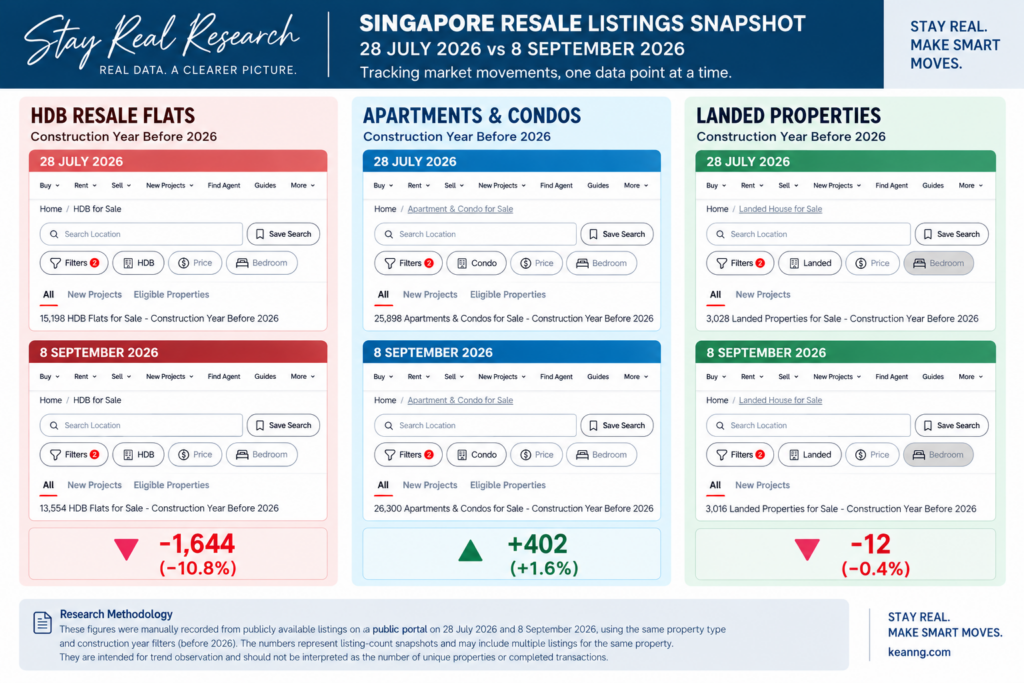
| Resale listing snapshot | 28 Jul 2026 | 8 Sep 2026 | Change |
|---|---|---|---|
| HDB flats | 15,198 | 13,554 | −10.8% |
| Apartments & condos | 25,898 | 26,300 | +1.6% |
| Landed properties | 3,028 | 3,016 | −0.4% |
The biggest movement was clearly in HDB.
The observed HDB listing count fell from 15,198 to 13,554.
That’s 1,644 fewer listings, or approximately 10.8%, in about six weeks.
At the same time, apartment and condo listings moved in the opposite direction, increasing from 25,898 to 26,300, or around 1.6%.
Landed listings were almost unchanged.
So what does this tell us?
Does This Mean the Policy Caused HDB Listings to Fall?
No.
And I think this is an important distinction.
My research tracks listing counts displayed on a public property portal. These are not necessarily unique properties, and they are not completed transactions.
Listings can disappear for many reasons. A property could have been sold, withdrawn, expired or relisted. The same property may also be marketed through multiple listings.
Most importantly, six weeks is far too short to establish cause and effect.
So I wouldn’t say:
“The removal of the 15-month wait caused HDB listings to fall by 10.8%.”
What I can say is:
Six weeks after the policy change, the direction of movement is worth watching.
And there is another important supply factor that makes these numbers even more interesting.
13,500 BTO Flats Are Reaching MOP This Year
Around 13,500 BTO flats are expected to reach their five-year Minimum Occupation Period (MOP) in 2026, compared with about 8,000 in 2025.
And this number is expected to rise further to 15,000 in 2027 and 19,500 in 2028.
Why does this matter?
Because once these flats reach MOP, they become eligible to enter the resale market.
But eligible to sell does not mean the owners will sell.
Many will continue living in their homes. Others may rent them out, while some may eventually sell and upgrade.
Still, it means the potential pool of resale flats is growing.
And yet, during my six-week research period, the observed HDB listing count actually moved from:
15,198 → 13,554
That’s why I don’t think we should look at one number in isolation.
On one side, we have more flats reaching MOP, potentially adding future resale supply.
On the other, my listing snapshot currently shows fewer HDB listings than six weeks ago.
The question now is:
Will the upcoming MOP supply eventually replenish resale listings, or will market demand continue absorbing available supply?
That’s something I want to continue tracking.
HDB Prices Are Not Suddenly Surging Either
This is another important part of the story.
If HDB listings have fallen by 10.8%, we might assume prices must be shooting upwards.
But that’s not what the broader market data is showing.
According to the August 2026 99.co-SRX flash estimates, overall HDB resale prices increased only 0.1% month-on-month. Compared with August 2025, overall prices were actually 0.5% lower.
August recorded 2,524 HDB resale transactions, down 5.1% from July, although transaction volume remained 14.1% higher than a year earlier.
So at the moment, I’m not seeing evidence of another broad HDB price surge.
Instead, the market appears to be becoming more selective.
But Premium HDB Flats Are Telling a Different Story
This is where things get interesting.
PropertyGuru reported that enquiries for HDB flats priced at $1 million and above increased 154% in the first full week after the removal of the 15-month wait-out period.
By comparison, enquiries for flats around the $200,000 price range increased by roughly 8%.
We need to be careful here.
These are enquiries, not transactions, and the data doesn’t tell us whether every person making an enquiry was previously a private property owner.
But it does show where buyer interest increased most strongly immediately after the policy change.
Then came August’s transaction numbers.
Singapore recorded 201 HDB resale transactions of at least $1 million in August, the first time the monthly figure crossed 200.
These transactions accounted for about 8% of total HDB resale volume.
Interestingly, Executive flat prices increased 2.8% month-on-month, while 5-room flat prices were unchanged and 3-room flat prices fell 0.3%.
This is why I don’t think we should talk about “the HDB market” as though every flat is behaving the same way.
We may be seeing a more two-speed market:
Premium, larger and well-located flats may continue attracting strong demand, while the broader HDB resale market remains relatively stable.
What About Condo Resale Listings?
This was one of the areas I was particularly interested in when the 15-month rule was removed.
My Stay Real Research recorded:
28 July: 25,898 apartment & condo listings
8 September: 26,300 apartment & condo listings
That’s an increase of 402 listings, or approximately 1.6%.
Why am I watching this?
Because removing the 15-month wait makes the right-sizing journey much easier for eligible private homeowners.
Previously, many owners faced something like:
Sell private property → find temporary accommodation → wait 15 months → buy HDB resale
Now, eligible homeowners can purchase a non-subsidised HDB resale flat without serving that 15-month wait, provided they meet the applicable conditions.
This could encourage some private homeowners who previously postponed their plans to finally make their move.
My condo listing snapshot has increased slightly since 28 July.
But a 1.6% increase over six weeks is nowhere near enough for me to say we’ve discovered a trend.
I want to see what happens over several more months.
Don’t Forget the 6-Month Disposal Rule
The removal of the 15-month wait does not mean private homeowners can simply keep both properties indefinitely.
Eligible buyers can purchase the HDB resale flat first, but they must dispose of all their private residential properties in Singapore and overseas within six months of completing the HDB purchase.
That’s an important difference.
It gives homeowners greater flexibility over the sequence of their move, but the private property still needs to be disposed of within the required timeline.
The 30-Month Rule Has Not Disappeared
Another common misunderstanding is that every private homeowner can now immediately purchase any HDB flat.
That’s not the case.
The policy change mainly affects eligible buyers purchasing a non-subsidised HDB resale flat without taking an HDB housing loan.
The separate 30-month wait-out period still applies in situations including purchasing subsidised flats, receiving CPF housing grants, purchasing a new Executive Condominium from a developer, or taking an HDB housing loan.
So anyone planning to right-size should check their individual eligibility before selling or buying.
Could the Rental Market Be Affected?
There is another possible effect that receives less attention.
Under the previous rule, some private homeowners would sell their private property and then need temporary accommodation while waiting 15 months before they could purchase an HDB resale flat.
Some became tenants during that period.
For eligible buyers, that waiting period has now disappeared.
This therefore removes one source of temporary rental demand.
Does that mean Singapore rents are going to fall?
Not necessarily.
Rental demand is influenced by many other factors, including employment, immigration, household formation and housing completions.
But this is another small part of the market that I think is worth monitoring.
So What Is the Market Telling Us Six Weeks Later?
I wouldn’t conclude that the removal of the 15-month rule has transformed the property market.
It’s too early.
But there are already several interesting signals.
My Stay Real Research shows HDB listing counts down 10.8%, while condo listing counts are up 1.6%.
At the same time, 13,500 BTO flats are reaching MOP this year, potentially creating additional resale supply.
Overall HDB resale prices are relatively stable, but million-dollar HDB transactions reached a record 201 in August, suggesting the premium segment is behaving differently from the broader market.
That tells me something important:
There isn’t one single Singapore property market.
Different segments can move in different directions at the same time.
What I’ll Track Next
This is only the second Stay Real Research snapshot.
I’m going to continue using the same filters and record the numbers again.
I want to see whether:
- HDB listing supply remains below the July level;
- condo resale listings continue increasing;
- the 13,500 flats reaching MOP begin appearing in resale supply;
- premium HDB demand remains strong; and
- the removal of temporary rental demand becomes visible in rental-market data.
Over several data points, we’ll have a much better picture than we can get from one policy announcement or one month of transactions.
Research Methodology
The Stay Real Research listing figures were manually recorded from publicly available listings on a public property portal on 28 July 2026 and 8 September 2026, using the same property-type and “construction year before 2026” filters.
The figures represent listing-count snapshots. They are not verified counts of unique properties or completed transactions and may include multiple listings relating to the same property.
The purpose of this research is to observe directional changes over time, rather than present the figures as official market statistics.
My Stay Real Thought
When a major property policy changes, it’s easy to make a prediction.
HDB prices will rise. Condo prices will fall. Rental demand will drop.
But property doesn’t usually work in such a straight line.
Six weeks later, we’re already seeing different signals.
HDB listing counts in my research have fallen, yet thousands of BTO flats are reaching MOP and creating potential future supply.
Overall HDB prices remain relatively stable, yet the million-dollar segment just recorded a new high.
Condo listing counts have increased slightly, but it’s still far too early to say that private homeowners are rushing to sell.
That’s why I prefer to keep tracking the numbers instead of reacting to one headline.
The next few months will tell us much more.
Are you thinking of selling your private property and right-sizing to an HDB, or wondering whether now is the right time to sell your HDB and upgrade?
A policy change may open up new options, but the right decision still depends on your sale proceeds, CPF, outstanding loan, financing, timeline and longer-term property plans.
Before making the move, understand your numbers first.
Get in touch with me for more information.
📚 Related Articles
➡️ How Much Is My HDB Worth In 2026?
➡️ Rare Dual-Key HDB Flats: Are They Worth Buying?
➡️ 5 Lesson Every HDB Owners Can Learn
➡️ Real Upgrade Journey: HDB to Condo Guide
➡️ What Should You Do With Your Property Profits?
➡️ Best Advice Not To Sell Your HDB Yet
➡️ Why Real Estate Is a Powerful Wealth Building Tool
➡️ 15 months wait out period removed: What it mean for homeowners