


You bought your property for $800,000.
Today, it’s worth approximately $1.2 million.
That’s a $400,000 increase.
So does that mean you’ll receive $400,000 cash profit when you sell?
Not necessarily.
This is one of the areas that can be confusing for homeowners.
The estimated value of your property is important, but if you’re thinking of selling, upgrading or right-sizing, there’s another number that’s arguably even more important:
How much cash and CPF will you actually have after the sale?
Let’s break it down.
👉 CHECK MY ESTIMATED PROPERTY VALUE
Your Selling Price Is Not Your Cash Proceeds
When homeowners see how much their property has appreciated, it’s easy to calculate:
Current Value – Original Purchase Price = Profit
But that doesn’t tell you how much cash you’ll receive when you sell.
A more useful calculation starts with:
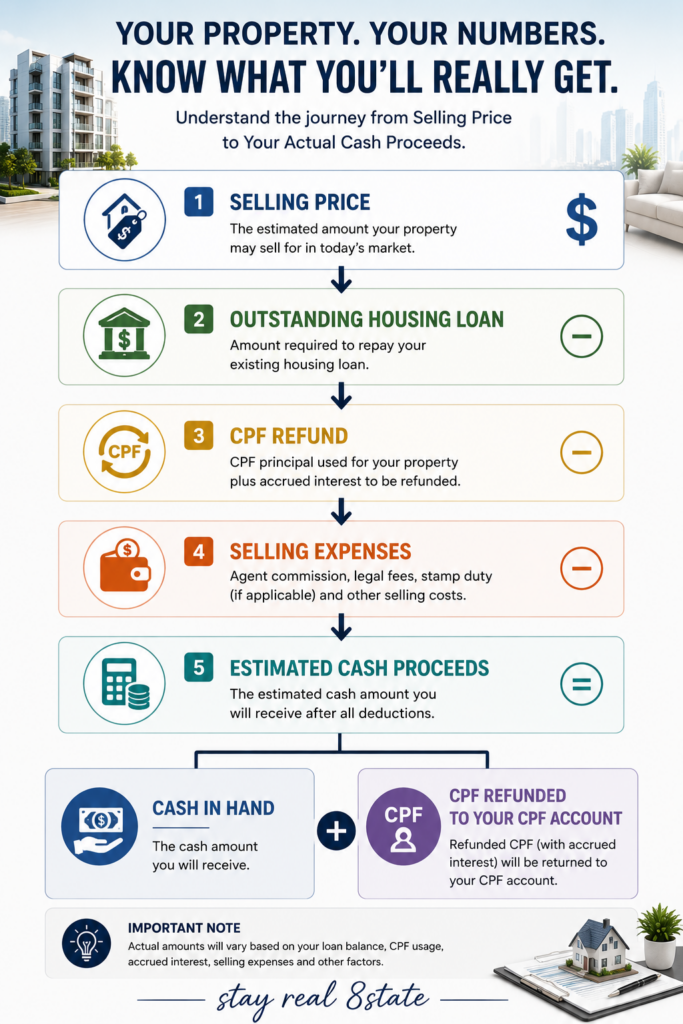
This gives you a much clearer picture of your financial position after selling.
Step 1: Find Out What Your Property May Be Worth
Before calculating anything, you first need a reasonable estimate of your property’s current market value.
You can start with an online property valuation.
But remember that an automated valuation is only an estimate.
Your eventual selling price may also depend on factors such as:
- Recent transactions
- Current competing listings
- Floor level
- Facing and view
- Property condition
- Renovation
- Layout
- Location
- Current buyer demand
Once you have a realistic estimated selling price, you can start calculating your potential sale proceeds.
Step 2: Deduct Your Outstanding Housing Loan
If you still have an outstanding mortgage, the loan generally needs to be redeemed from your sale proceeds.
For example:
Selling Price: $1,200,000
Outstanding housing loan:
$350,000
After repaying the loan:
$1,200,000 – $350,000 = $850,000
But we’re not finished yet.
Step 3: Don’t Forget Your CPF Refund
This is where some homeowners get surprised.
If you’ve used CPF savings to:
- Pay your down payment
- Pay monthly housing instalments
- Pay certain eligible property-related costs
the applicable CPF amount generally needs to be refunded to your CPF account when you sell.
And it’s not necessarily just the original CPF amount used.
There wil be accrued interest.
In simple terms, accrued interest is the interest your CPF savings could have earned if the money had remained in your CPF account.
So if your CPF principal used plus accrued interest is:
$250,000
our calculation becomes:
$850,000 – $250,000 = $600,000
That $250,000 isn’t simply “lost”.
It is generally refunded back into your CPF account, subject to the applicable CPF rules.
This distinction is important when planning your next property.
Step 4: Deduct Your Selling Expenses
Selling a property also comes with expenses.
Depending on your property and circumstances, these may include:
- Property agent commission
- GST on the agent’s commission
- Legal/conveyancing fees
- Mortgage redemption-related charges, where applicable
- Seller’s Stamp Duty, if applicable
- Other administrative or transaction-related costs
Let’s use $30,000 as a simplified illustration.
Our calculation now becomes:
$600,000 – $30,000 = $570,000
Your estimated cash proceeds would therefore be approximately:
$570,000
And approximately $250,000 would have been refunded to your CPF account in this simplified example.
So Did You Really Make $400,000?
Let’s return to our original example.
You bought at:
$800,000
You sold at:
$1,200,000
The difference is:
$400,000
But calling the entire $400,000 your “cash profit” can be misleading.
During the years you owned the property, you may have:
- Paid down part of your housing loan
- Used CPF for instalments
- Paid mortgage interest
- Paid maintenance fees
- Paid property tax
- Spent money on renovation
- Paid buying and selling expenses
At the same time, part of the proceeds you receive upon sale may simply represent the equity you’ve built by paying down your loan over the years.
That’s why I prefer to separate two questions:
“How much has my property appreciated?”
and
“How much cash and CPF will I have after selling?”
They are not the same calculation.
A Simple Property Sale Proceeds Example
Let’s put everything together.
| Item | Amount |
|---|---|
| Estimated Selling Price | $1,200,000 |
| Less: Outstanding Housing Loan | ($350,000) |
| Less: CPF Refund | ($250,000) |
| Less: Estimated Selling Expenses | ($30,000) |
| Estimated Cash Proceeds | $570,000 |
| CPF Returned to CPF Account | $250,000 |
So after selling, your position could approximately be:
Cash: $570,000
CPF: $250,000
Combined Cash + CPF Position: $820,000
This is a simplified illustration only, but it shows why looking at the selling price alone doesn’t give you the full picture.
What If I Fully Paid Off My Property?
This is where things become interesting.
Suppose your property is worth $1.2 million and you no longer have an outstanding housing loan.
You may think:
“Great, I’ll receive almost $1.2 million.”
Not necessarily.
If CPF was previously used for the property, the applicable CPF principal and accrued interest still need to be refunded upon sale.
Selling expenses also need to be considered.
However, because there’s no outstanding mortgage to redeem, your total available cash and CPF position could naturally be much stronger.
This is why two homeowners selling identical properties at exactly the same price can walk away with very different amounts of cash.
Two Neighbours Sell at the Same Price: But Their Cash Proceeds Can Be Very Different
Imagine two neighbours both sell their flats for:
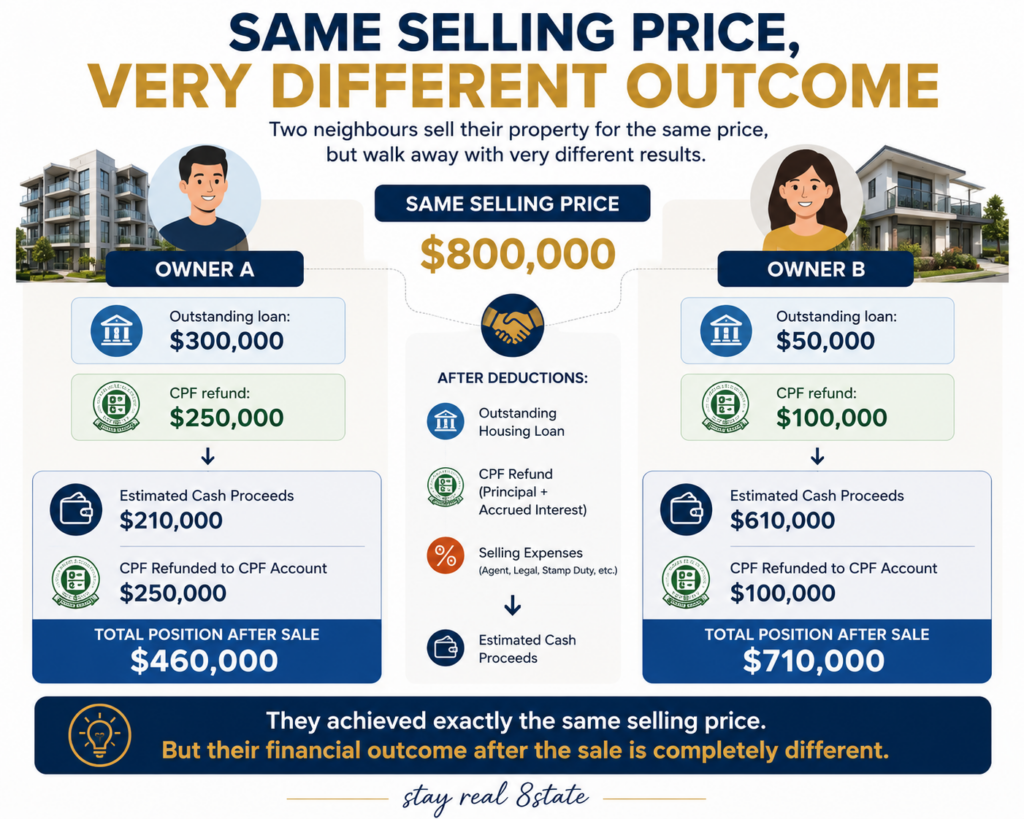
This is why asking:
“How much did my neighbour sell for?”
is useful.
But asking:
“What does selling at that price mean for MY finances?”
is much more important.
Your Property Made Money – But So Did the Property You Want to Buy
There’s another side to this that homeowners sometimes overlook.
Suppose you bought your property for:
$800,000
Today it’s worth:
$1.2 million
Great, your property has appreciated by $400,000.
But imagine the property you wanted to upgrade to used to cost:
$1.3 million
and today costs:
$1.9 million.
Your current property increased by:
$400,000
But your next property increased by:
$600,000
So although your property made money, the price gap to your next home has widened.
This is why property planning shouldn’t stop at:
“My property made $400,000.”
The more important question is:
“Where does that $400,000 put me relative to my next property?”
Before Selling, Calculate Your Next Property Budget
If you’re thinking about selling and upgrading, I prefer looking at the entire journey:
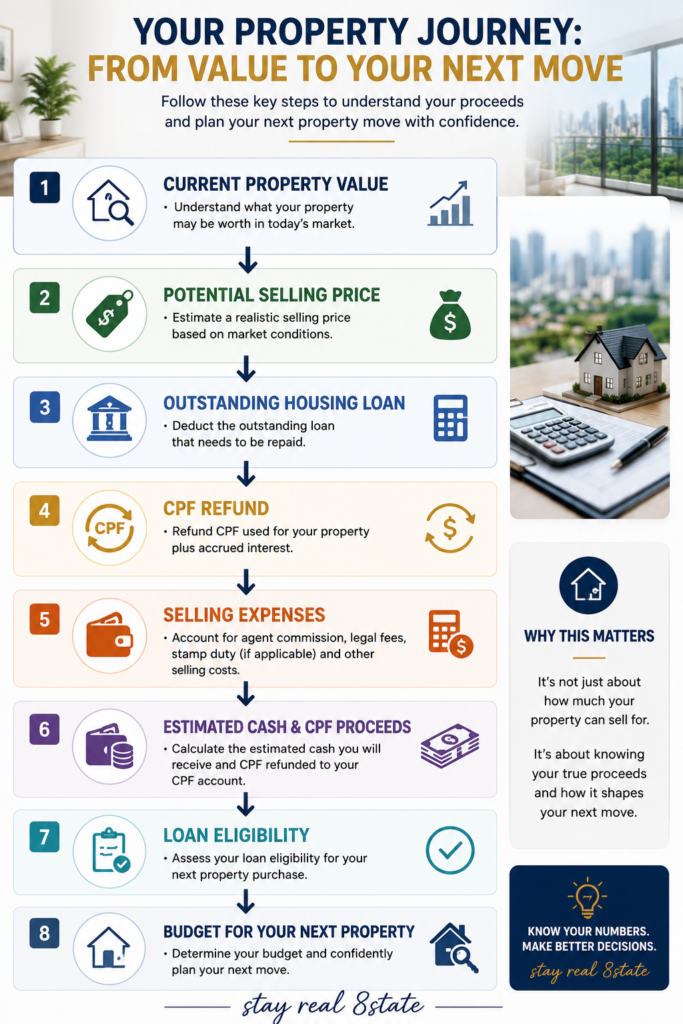
Budget for Your Next Property
This is where property valuation becomes useful.
You’re no longer checking your property’s value simply because you’re curious.
You’re using the number to make your next property decision.
What If I’m Right-Sizing for Retirement?
The same calculation is equally important for homeowners planning to right-size.
Perhaps your property has appreciated substantially over the years.
You may be thinking of selling your current home, purchasing a smaller property and freeing up some money for retirement.
Instead of asking only:
“How much can I sell my property for?”
I would calculate:
How much will I receive?
How much goes back into CPF?
How much cash remains?
How much will my next home cost?
How much cash will I have left after buying my next property?
That final number may be much more meaningful than the headline selling price.
How Can I Check My Property Value?
If you want a starting point, you can first check your property’s estimated value online.
👉 CHECK MY ESTIMATED PROPERTY VALUE
Whether you own an HDB flat, condominium, apartment or landed property, an estimated valuation can give you a general indication of where your property stands.
If you’re seriously considering selling, the next step is to look at your actual numbers and current market competition.
Frequently Asked Questions
How much cash will I get after selling my property?
It depends on your selling price, outstanding housing loan, CPF refund requirements, selling expenses and other applicable costs. Two owners selling at the same price may receive very different cash proceeds.
Do I need to refund CPF when I sell my property?
If CPF savings were used for the property, the applicable CPF principal used and accrued interest generally need to be refunded to your CPF account upon sale, subject to CPF rules and your circumstances.
Is CPF refund considered a loss?
Not in the same way as an expense. The required CPF amount is generally returned to your CPF account rather than being paid to another party. However, it affects how much of your sale proceeds you receive directly as cash.
Is property appreciation the same as profit?
Not necessarily. The difference between your purchase and selling prices doesn’t account for financing costs, CPF usage, renovation, transaction expenses, taxes, maintenance and other ownership costs.
Should I check my property value before selling?
Yes, it can provide a useful starting point. However, if you’re seriously considering selling, you should also assess recent transactions, current competition, your property’s characteristics and buyer demand.
My Stay Real Thought
When homeowners tell me:
“My property has gone up by $300,000 or $400,000.”
That’s definitely something worth looking at.
But I don’t think the conversation should end there.
I would want to know:
How much loan is left?
How much CPF needs to be refunded?
How much cash will you actually receive?
And most importantly:
What do you want to do with the money after you sell?
If you’re upgrading, let’s calculate whether the next property is comfortably affordable.
If you’re right-sizing, let’s see how much cash you can potentially free up.
If you’re planning for retirement, let’s look at what your financial position may be after buying your next home.
A higher property value is good news.
But knowing what that value can actually do for you is even more important.
Know the numbers before making the move.
Stay Real 8state
Want to Know What Your Property Is Worth – And What You Could Walk Away With?
Start by checking your estimated property value.
Then, if you’re seriously considering selling, I can help you work through your potential cash proceeds, CPF refund and next-property budget.
👉 CHECK MY ESTIMATED PROPERTY VALUE
👉 CONTACT ME FOR A PROPERTY FINANCIAL REVIEW
Property valuations and financial examples shown are estimates and illustrations for general information only. Actual CPF refunds, loan redemption amounts, expenses, taxes and sale proceeds depend on individual circumstances and prevailing rules.
📚 Related Articles
➡️ 5 Lesson Every HDB Owners Can Learn
➡️ Real Upgrade Journey: HDB to Condo Guide
➡️ What Should You Do With Your Property Profits?
➡️ Best Advice Not To Sell Your HDB Yet
➡️ Thinking of Selling Your Condo? Check Its Estimated Value First
➡️ 15 months wait out period removed: What it mean for homeowners